Combat Cognition Beta: Train the Space Between Classes
We’re opening a focused beta for gyms and serious practitioners. Here’s the problem we’re solving, how the app is built around learning science, and how to get involved.
Introduction
If you train grappling, striking, or any combat sport seriously, you already know the paradox: the mat is where skill is proven, but most of your week is not on the mat. Recovery, work, family, and plain fatigue mean you can’t (and shouldn’t) live in the gym. The question is what to do with the rest of the week so that your next session actually builds on the last, instead of feeling like you’re always restarting from zero.
That gap is what Combat Cognition is for. It isn’t a replacement for training. It’s a training operating system for the hours in between. Muscle memory sticks when you log real sessions across grappling, striking, conditioning, and strength and pair them with short guided mental rehearsals built from each technique’s concept and drilling steps. Spaced review keeps rehearsal specific; caps and rules keep it sustainable. Engagement (streaks, milestones, reminders designed not to punish you for recovery) helps you stay with it long enough for the habit to matter.
Today I’m announcing a beta focused on selected partner gyms. The goal is to prove the loop in real academies (coaches, culture, and mixed levels) before we widen the doors.
The consumer problem: skill acquisition and load management
Two things compete in every athlete’s head:
- You want more reps since reps are how the techniques become automatic.
- You have a body, so more mat time without recovery and variety is how people get injured or burnt out.
So the real skill, for both hobbyists and competitors, is load management and optimising your downtime: enough stress to adapt, enough downtime to consolidate. Neuroscience treats memory consolidation as something that continues after the physical event. Mental imagery is not a folk remedy: motor-learning research has repeatedly shown that structured visualization can speed acquisition and shore up the same motor-memory circuits you stress on the mat. But if mental work isn’t anchored to sound visualization of what you already practice (not loose imagery with no relation to real reps), it’s easy to waste time.
How Combat Cognition closes the loop
The core experience is deliberately simple to describe:
- You train in the real world and log sessions, including tagging techniques when they matter.
- Between sessions, you open short guided visualization blocks built from how a technique is actually drilled (setup, entries, steps), not from vague “imagine winning” scripts.
- After each block, you give a quick honest quality signal (how clear the rehearsal felt). That feeds a spacing schedule tuned for motor memory (when to come back), not a one-size-fits-all streak gimmick.
- The product also caps weekly visualization days on purpose, aligned with research on sustainable mental-training dose, so a supplement doesn’t turn into a second job.
Under the hood, formal rules keep the philosophy honest: for example, you shouldn’t be nudged into heavy mental rehearsal of a technique you’ve never physically touched, and mental work is timed to respect consolidation, not to squeeze extra “points” out of the same night you just taxed on the mat.
Neuroscience, behavioral psychology, and why the details matter
Visualization that behaves like motor practice
Research on mental imagery consistently frames it as additive: it can speed learning and stabilize memory for real-world skills, but it doesn’t replace executing those skills in the real environment. We took that stance seriously in product design: guided imagery is step-synced, brief, and repeatable, mirroring how you’d actually chain a drill, not a single long meditation where your mind wanders.
Scheduling and feedback that match how athletes learn
Spacing algorithms are famous in language apps, but their applicability is far wider than just language. Our scheduling adapts to graded rehearsal quality (including nuance like “I got most of it” versus “barely”) so the system isn’t punishing you with binary failure for the messy reality of skill execution.
Engagement that doesn’t punish you for following medical common sense
Training products often weaponize streaks: miss a day and your identity in the app resets to zero. That can backfire for people who are already punishment-sensitive. Where Combat Cognition uses streaks, leaderboards, achievements, and notifications, the philosophy is different: persistence should feel fair. If the product’s own rules cap how many visualization days count in a week, we don’t treat the rest of the week off the mats like a moral failure. The experience still nods to what you’ve achieved before and treats small, real behaviors (strength and conditioning included) as part of the picture, not as fluff.
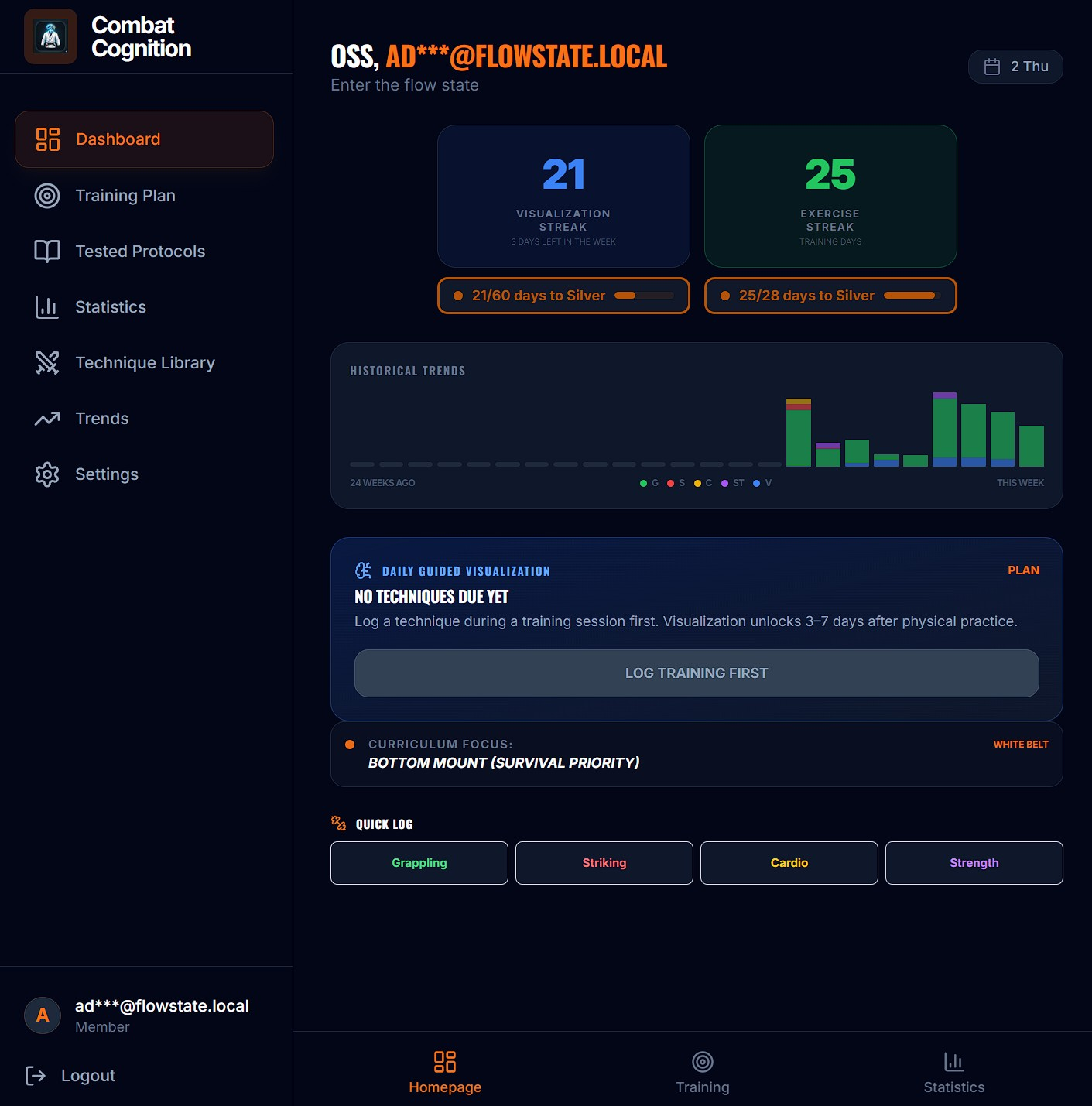
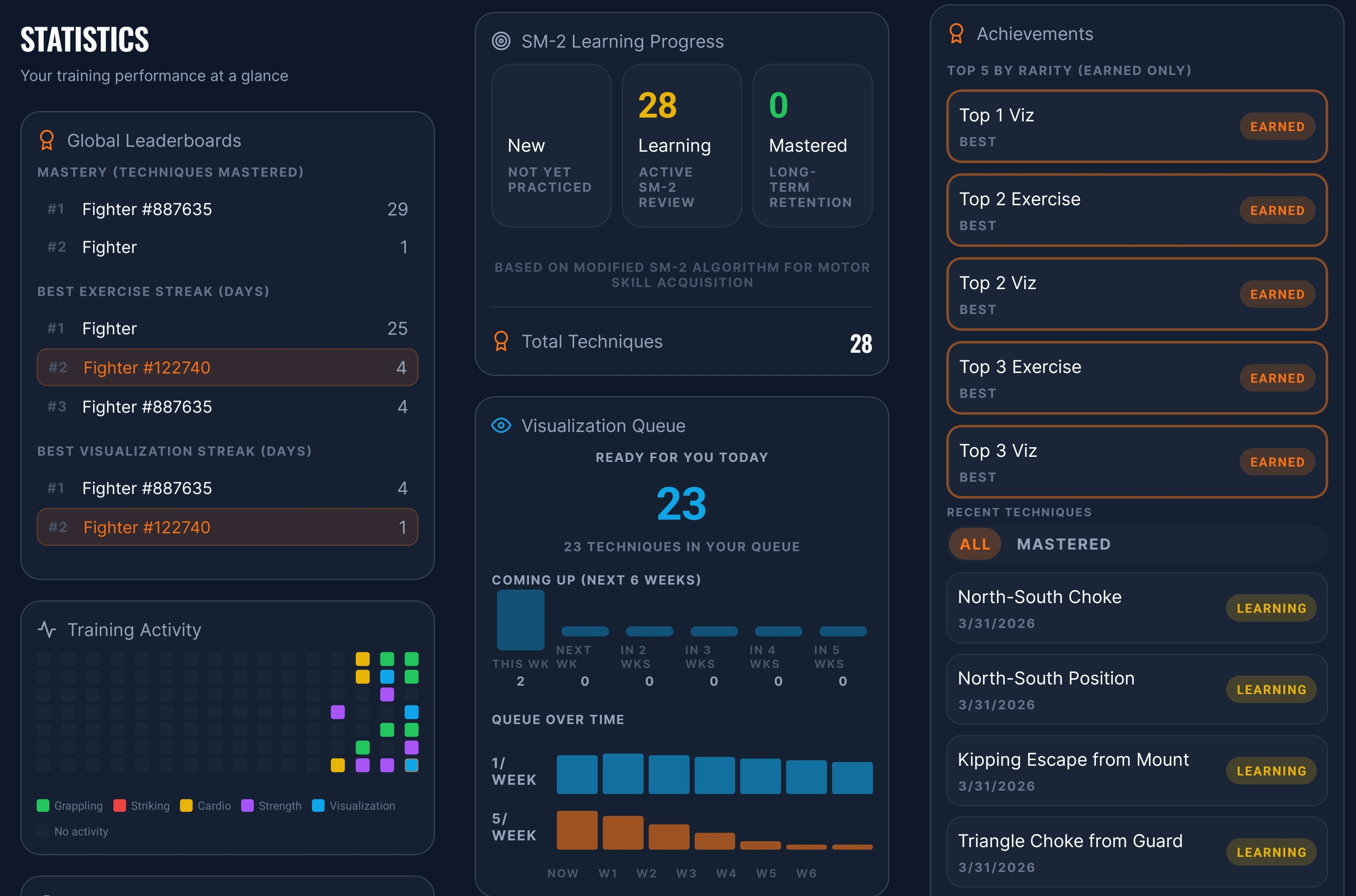
Inside the app (screenshots from our Web and Mobile Apps)
Below are current screenshots of the web and mobile dashboard and statistics pages. They are designed to be highly similar, so the choice of one versus the other is purely for layout alignment with this article:
Beta and go-to-market: partner gyms first
Combat Cognition is in early beta on Android (Google Play) and iOS. Rather than spraying a generic open signup and hoping for signal, we’re inviting selected gyms to participate first.
If you run an academy or you’re a serious student at one, and you want your gym considered for the partner beta, reach out through the contact page on this site with the gym name, location, and a short note on how you train (contact). We’ll reply with onboarding details if you seem like a fit.
Future
Check back here on my site and follow my LinkedIn for more information about development philosophy, rollout process, and feature updates over the coming months.
Combat Cognition is the project I’ve been building to connect real mat time with disciplined mental rehearsal and scheduling you can trust. If you’re trying to get better through proven science without pretending recovery doesn’t exist, this app is built for you.